
The COVID-19 pandemic has wreaked havoc on the tourism industry. With many restrictions and safety protocols in place, King Salama Safaris must stay current on what is happening so we can guide our guests on the way to travel safely to Kenya. The best way to get this information is through first-hand experience.
As a tour operator, it was important for me to travel for my company. I was initially anxious about traveling to Kenya during the COVID-19 pandemic. I was extremely pleased to see how well organized and effective Kenya has been at stopping the spread of the coronavirus. I’m happy to be able to share those experiences with you as you make your decision on whether or not to visit this amazing African country.
Kenya’s Response to the COVID-19 Pandemic
The first thing to note is that Kenya has done an amazing job managing the COVID-19 pandemic. They were the first African country to lockdown their major cities. This had a huge impact and helped to reduce the spread of the virus to rural areas.
Because of this effort, the nation of Kenya was awarded the Safe Travel Stamp from the World Travel and Tourism Council (WTTC) on July 1st, 2020. This award recognized Kenya for its efforts in embracing the ‘Safe Travels’ standards which required the adoption of global health and hygiene standardized protocols.
Kenya was also the first country in the world to be awarded the Safer Tourism Seal by Rebuilding Travel on August 27th, 2020.
By August 1st, 2020, the Kenyan government decided that it was safe enough to resume international flights.
Documents You Need Before You Go
To visit Kenya during the pandemic, you are required to fill out some additional forms and get tested for COVID-19 before your departure. It is recommended that you check out the US Embassy’s website for the latest information as regulations can and will change.
Visa – For US citizens, getting a visa is easy. It’s recommended that you fill out your visa application at least two weeks before your trip. The cost to complete this is about $52. You can hire a company to help secure your visa, but you can expect to be charged more for their services.
COVID-19 Test – Passengers arriving in Kenya must show proof that they have a negative test result within 96 hours of arrival by presenting the certificate from a PCR COVID-19 test. I was able to get mine quickly through a rapid testing site. I recommend others do the same since there are scheduled appointments and no long waits.
Ministry of Health Form – The forms from the Ministry of Health take about two minutes to complete. Once done, you’ll receive a QR code that can be scanned on arrival.
Flying to Kenya
Flying to Kenya
In December, I made my first trip to Kenya since the pandemic started. I flew Kenya Airways and was fortunate enough to get on their very first flight out of New York since flights had stopped due to the pandemic. One of their best things about Kenya Airways is that they have direct flights between New York and Nairobi for an affordable price.
Arriving at JFK airport, I found a quiet and partially empty terminal. I proceeded to the Kenya Airways check-in desk. I noticed groups of unhappy passengers who had been turned away because they didn’t have their PCR COVID-19 test results. It was apparent that Kenya Airways was enforcing the strict policy that is clearly stated on their website.
In addition to strict check-in protocols, the airline also implemented additional protection for COVID-19 prevention such as the installation of High-Efficiency Particulate Air (HEPA) filtration systems on the aircraft to help keep the air clean during flights.

Landing in Nairobi, Kenya.
Arriving at the airport in Nairobi, you are met by medical staff who check your temperature and scan your QR code from the Ministry of Health before proceeding to immigration. To expedite the process, you should be sure to have your documents in order. I had the code ready on my phone and was out of the airport in about 15 minutes.
Aside from King Salama Safaris, I only saw one other tour operator waiting to pick up arriving guests. It was immediately apparent that the pandemic had significantly impacted the tourism industry. With a decrease in tourism by 98 percent, there are many negative impacts to the communities and wildlife preservation that rely on tourism dollars.
I spent my first night in Nairobi at Villa Rosa Kempinski. While most hotels in Nairobi have a security checkpoint, there are now additional COVID-19 precautions. After having my temperature checked and hands sanitized, I headed off to my room.
My room was not only luxurious but also very clean. The hotel staff was constantly cleaning and wore their masks at all times.
The next morning, I left for Elewana Tortilis Camp in Amboseli. My driver was cautious to follow all of the strict protocols for drivers set by the Kenyan government. He wore a mask the whole trip even though the vehicle was quite open and provided plenty of fresh air. I decided to also keep my mask on for the ride.
In order to operate, lodges must have a certificate permitting them to open. To obtain this certificate, the lodges must follow all guidelines including temperature checks, sanitizing stations, extra cleaning, and staff testing. All of the camps that I visited had the same COVID-19 protocols.
As I arrived at Elewana Tortilis Camp, I was greeted by the camp manager and staff who are all wearing masks. Despite the restrictions, they still managed to give me a warm welcome and a delicious mocktail. My temperature was taken, and I sanitized my hands before proceeding. I arrived on the weekend and the camp was a little busy, by pandemic standards. There were a few international guests like me, but most were locals from Nairobi on a weekend retreat.
The camp was beautiful with fantastic views of Mount Kilimanjaro which can be seen on a clear day. I was fortunate to get a tent that faced Mount Kilimanjaro. It was quite surreal waking up in the morning and enjoying the fantastic view over a cup of tea.
I wore my mask when visiting the communal areas, but they were mostly outdoors and there wasn’t much need to do so. Plus, there are several communal areas and a pool, so social distancing is not a problem.
Ol Pejeta Conservancy
My next stop was the Ol Pejeta bush, in Ol Pejeta Conservancy. It’s a remote area of the Conservancy and only has seven tents. Moses, the camp manager, and his staff made me feel at home while maintaining social distance. The camp was beautiful and offered plenty of wide-open space.
Ol Pejeta Bush Camp is one of the few camps that has an electric car for game drives. I was lucky enough to be able to go on a night drive in one. It’s not only good for the environment but makes for a smooth quiet ride. This helps keep the wildlife from being scared away. I had the entire vehicle to myself, so there was little need to wear a mask.
One of the highlights of my visit was seeing the last two Northern White Rhinos on the planet. I was the only visitor, so I had them to myself and spent about an hour observing and learning all about them.

Saruni Samburu Camp
Next, I went to Saruni Samburu Camp which is perched on the top of a mountain in Kalama Conservancy. This camp is as private as it gets since it is the only camp in the whole conservancy and has only six rooms. Factoring in tourism being dramatically affected because of COVID-19, you feel like you have the place to yourself. The camp managers were great hosts and went above and beyond to make sure my stay was perfect.
When I walked into my room, I was blown away. It was massive and the most unique room I had ever been in with two viewing decks to sit out on and relax while overlooking the vast view of the beautiful wilderness.
There were plenty of options for social distancing. The camp has two pools to choose from. The lounge and dining were also spaced out and open-air, with breathtaking views in every direction.
Game drive vehicles were open and didn’t require a mask. Once again, I had the vehicle to myself with my expert Samburu guide, Simon.

Reteti Elephant Sanctuary
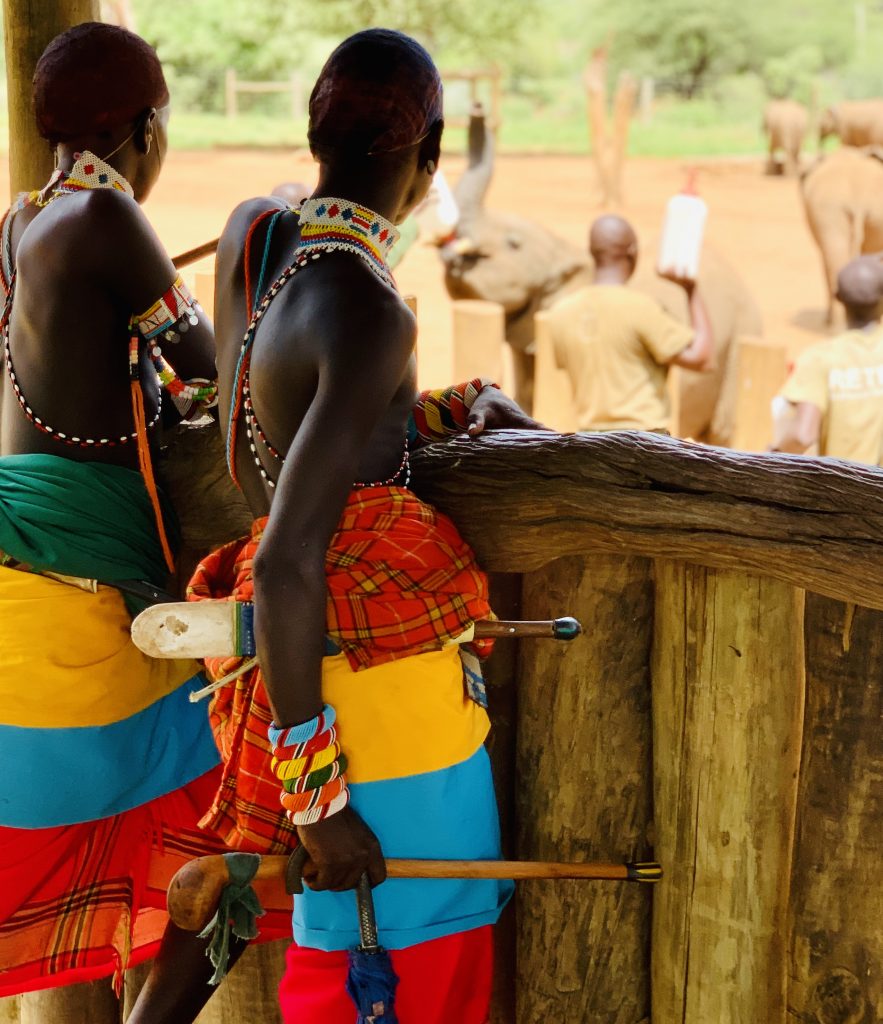
The following day, I went to Reteti Elephant Sanctuary, a community-run sanctuary that rescues orphaned and abandoned elephant calves.
There were only two other visitors who were both locals from the Samburu tribe. They had walked miles to get there. Learning their stories and watching the elephants’ feeding time was a lot of fun,
I was fortunate enough to hang out with and feed the two resident Kudu antelope that had been rescued.
This is a very remote area in Kenya, so I did keep my mask on (except for a photo) just to keep staff safe.
My last stop was Elephant Bedroom Camp in Samburu. After I went through sanitation protocols, I walked into camp and was greeted by a big bull elephant who was making his way through camp. The camp is known for its elephant visits, hence the name Elephant Bedroom. Don’t worry, there is plenty of staff around to make sure you are safe.
The rooms were beautiful and cozy. I loved spending time on my deck that overlooked the Ewaso Nyiro River. There was also a small pool on my private deck.


Heading Home to New York
Returning from Kenya, you need to show negative COVID-19 test results completed within 72 hours (three days) of arriving in New York. I did mine at Amref to save time. I filled out the application online ahead of time and took it with me as it can get busy there. I arrived at the testing center an hour before they opened. On some days there can be lots of people waiting, but fortunately, there weren’t many. The results should arrive within 24 hours, but I received them by 8 pm the same day. The results come via email and are easy to get printed at your hotel.
Once I arrived in New York (JFK airport), I passed through immigration quickly. Once I had passed baggage, I was stopped to fill out a form, which I had already done. I just provided the completed form and I was on my way.
Make Kenya Your Next Trip
While it was great being one of the few guests at the camps, having private game drives, and short lines at the airport, it was not good for the Kenyan people. Throughout my trip, I saw the resilience in the Kenyan people who have had a tough time. Despite this, they did not show their struggle.
After living cautiously, some might say over cautiously in New York, I felt very relaxed and free in Kenya. Most of the rural areas had no recorded COVID-19 cases. The people in a remote Samburu village that I visited were intrigued to know what had been going on. I still kept my mask on around people, out of respect for their health, but was able to spend a lot of time without a mask.
Despite the uncertainty around the pandemic, you can still have an amazing experience and take advantage of the low numbers of tourists. If you are ready to plan your trip but still have concerns, let the experts at King Salama Safaris help you through the process.
.